

CAREER GUIDANCE INSIGHT
The Way Ahead — and the Right Degree to Get There
Artificial Intelligence has moved from a specialised research field to a mainstream career choice — one that now touches healthcare, finance, manufacturing, governance, and nearly every other industry. For a student choosing a degree today, AI is no longer a niche bet; it is fast becoming a default skill layer across technology careers.
But “getting into AI” is not a single decision made at one point in time. It is a sequence of choices — stream, degree, specialisation, and continuous skill-building — that together shape whether a student ends up genuinely job-ready or simply degree-holding. This guide lays out that sequence clearly, along with the career roles it leads to.
Why AI Is Attracting Serious Career Attention
Three shifts explain why AI has become a long-term career track rather than a passing trend:
- Every major industry — healthcare, banking, retail, manufacturing, agriculture — is actively adopting AI-driven tools, creating demand for talent that understands both the technology and the domain.
- The rise of generative AI has expanded the field well beyond traditional data science, opening new roles in applied AI, AI product development, and AI safety/ethics.
- Global and Indian technology companies, startups, and research institutions are all competing for the same relatively small pool of well-trained AI professionals — which keeps demand consistently ahead of supply.
Understanding the AI Career Landscape
“AI career” is really an umbrella term covering several distinct roles, each requiring a slightly different mix of skills:
- Machine Learning Engineer — builds and deploys models that power real products.
- Data Scientist — extracts insight and predictive value from large datasets.
- AI Researcher — works on advancing the underlying algorithms, often within a Master’s or PhD track.
- Computer Vision / NLP Engineer — specialises in image-based or language-based AI systems.
- AI Product Manager — bridges technical AI capability with business and user needs.
- AI Ethics & Policy Specialist — an emerging role focused on responsible and regulated AI deployment.
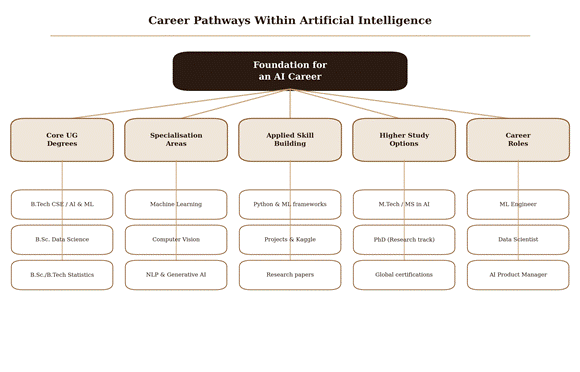
Fig 1: How a foundation in AI branches into degrees, specialisations, and career roles
The Way Ahead: Building the Right Degree Path
Because AI sits at the intersection of computer science, mathematics, and statistics, the strongest preparation starts early and builds in layers rather than being decided in a single leap after Class XII.
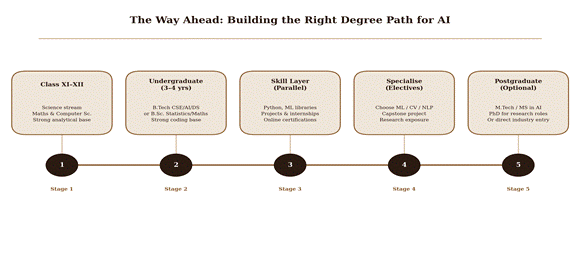
Fig 2: A staged roadmap from Class XII to an AI-ready career
Stage 1: Class XI–XII — Build the Right Base
The Science stream with Mathematics and Computer Science gives the strongest entry point into AI-focused degree programmes. Strong fundamentals in mathematics (probability, linear algebra, calculus) matter more at this stage than any specific coding language.
Stage 2: Undergraduate Degree — Choose the Right Programme
- B.Tech in Computer Science Engineering (with AI/ML specialisation where offered)
- Dedicated B.Tech in Artificial Intelligence & Machine Learning or Data Science
- B.Sc. in Statistics, Mathematics, or Data Science for a more analytical route
The specific degree title matters less than the strength of the mathematics, programming, and data-handling curriculum behind it — this is a key factor to evaluate while shortlisting colleges.
Stage 3: Skill Layer — Build Alongside the Degree
- Hands-on proficiency in Python and core ML frameworks (TensorFlow, PyTorch, scikit-learn)
- Real projects, internships, and open competitions (such as Kaggle) to build a portfolio
- Reading and eventually contributing to research papers for those aiming at research-track roles
Stage 4: Specialisation — Pick a Lane
By the second half of an undergraduate programme, most successful AI professionals narrow their focus — machine learning, computer vision, natural language processing/generative AI, or robotics — through electives, capstone projects, and internships in that area.
Stage 5: Postgraduate Study — Optional but Often Decisive
- M.Tech / MS in Artificial Intelligence or Data Science for deeper technical roles
- PhD for research-focused or academic careers
- Direct industry entry after undergraduate study, supported by strong projects and internships, for applied roles
What Matters Beyond the Degree
Employers and research institutions increasingly evaluate AI candidates on demonstrated ability, not just credentials. A few things consistently make the difference:
- A visible portfolio of projects — GitHub repositories, competition results, or deployed applications.
- Comfort with real-world, messy data — not just clean textbook datasets.
- Domain knowledge in at least one industry (healthcare, finance, retail) that AI is transforming.
- Ethical and responsible-AI awareness, which is becoming a genuine hiring criterion, not just a compliance checkbox.
Choosing the Right College and Course
A few factors are worth weighing carefully before finalising a college for an AI-focused degree:
- Depth and currency of the mathematics and machine learning curriculum, not just the programme name.
- Faculty research output and active industry collaborations or labs.
- Availability of internships, live projects, and placement track record in AI/data roles specifically.
- Access to computing infrastructure (GPUs/cloud credits) for practical model training.
How Legal & Academic Associates Can Help
Our admission counselling vertical helps students map the full journey into an AI career — from choosing the right Class XII stream and shortlisting the strongest B.Tech/B.Sc. programmes, to evaluating postgraduate options and handling the complete documentation process.
- Personalised evaluation of AI/CS/Data Science programmes based on curriculum depth, not just brand name.
- Guidance on entrance exams, portfolio-building, and higher-study options (MS/PhD, India and abroad).
- Complete documentation and application support at every stage.
Thinking about a future in AI? Talk to our admission counselling team for a personalised degree roadmap.
Legal & Academic Associates — Documentation. Direction. Delivered.